 Add to Chrome
 Add to Firefox
 Add to Edge
Diffusion-Inspired Reconfiguration of Transformers for Uncertainty Calibration
Feb 09, 2026
Uncertainty calibration in pre-trained transformers is critical for their reliable deployment in risk-sensitive applications. Yet, most existing pre-trained transformers do not have a principled mechanism for uncertainty propagation through their feature transformation stack. In this work, we propose a diffusion-inspired reconfiguration of transformers in which each feature transformation block is modeled as a probabilistic mapping. Composing these probabilistic mappings reveals a probability path that mimics the structure of a diffusion process, transporting data mass from the input distribution to the pre-trained feature distribution. This probability path can then be recompiled on a diffusion process with a unified transition model to enable principled propagation of representation uncertainty throughout the pre-trained model's architecture while maintaining its original predictive performance. Empirical results across a variety of vision and language benchmarks demonstrate that our method achieves superior calibration and predictive accuracy compared to existing uncertainty-aware transformers.

Federated Prompt-Tuning with Heterogeneous and Incomplete Multimodal Client Data
Feb 06, 2026This paper introduces a generalized federated prompt-tuning framework for practical scenarios where local datasets are multi-modal and exhibit different distributional patterns of missing features at the input level. The proposed framework bridges the gap between federated learning and multi-modal prompt-tuning which have traditionally focused on either uni-modal or centralized data. A key challenge in this setting arises from the lack of semantic alignment between prompt instructions that encode similar distributional patterns of missing data across different clients. To address this, our framework introduces specialized client-tuning and server-aggregation designs that simultaneously optimize, align, and aggregate prompt-tuning instructions across clients and data modalities. This allows prompt instructions to complement one another and be combined effectively. Extensive evaluations on diverse multimodal benchmark datasets demonstrate that our work consistently outperforms state-of-the-art (SOTA) baselines.
Causal Graph Learning via Distributional Invariance of Cause-Effect Relationship
Feb 03, 2026This paper introduces a new framework for recovering causal graphs from observational data, leveraging the observation that the distribution of an effect, conditioned on its causes, remains invariant to changes in the prior distribution of those causes. This insight enables a direct test for potential causal relationships by checking the variance of their corresponding effect-cause conditional distributions across multiple downsampled subsets of the data. These subsets are selected to reflect different prior cause distributions, while preserving the effect-cause conditional relationships. Using this invariance test and exploiting an (empirical) sparsity of most causal graphs, we develop an algorithm that efficiently uncovers causal relationships with quadratic complexity in the number of observational variables, reducing the processing time by up to 25x compared to state-of-the-art methods. Our empirical experiments on a varied benchmark of large-scale datasets show superior or equivalent performance compared to existing works, while achieving enhanced scalability.
Rethinking Cross-Modal Fine-Tuning: Optimizing the Interaction between Feature Alignment and Target Fitting
Jan 26, 2026Adapting pre-trained models to unseen feature modalities has become increasingly important due to the growing need for cross-disciplinary knowledge integration.~A key challenge here is how to align the representation of new modalities with the most relevant parts of the pre-trained model's representation space to enable accurate knowledge transfer.~This requires combining feature alignment with target fine-tuning, but uncalibrated combinations can exacerbate misalignment between the source and target feature-label structures and reduce target generalization.~Existing work however lacks a theoretical understanding of this critical interaction between feature alignment and target fitting.~To bridge this gap, we develop a principled framework that establishes a provable generalization bound on the target error, which explains the interaction between feature alignment and target fitting through a novel concept of feature-label distortion.~This bound offers actionable insights into how this interaction should be optimized for practical algorithm design. The resulting approach achieves significantly improved performance over state-of-the-art methods across a wide range of benchmark datasets.
Leveraging Soft Prompts for Privacy Attacks in Federated Prompt Tuning
Jan 10, 2026Membership inference attack (MIA) poses a significant privacy threat in federated learning (FL) as it allows adversaries to determine whether a client's private dataset contains a specific data sample. While defenses against membership inference attacks in standard FL have been well studied, the recent shift toward federated fine-tuning has introduced new, largely unexplored attack surfaces. To highlight this vulnerability in the emerging FL paradigm, we demonstrate that federated prompt-tuning, which adapts pre-trained models with small input prefixes to improve efficiency, also exposes a new vector for privacy attacks. We propose PromptMIA, a membership inference attack tailored to federated prompt-tuning, in which a malicious server can insert adversarially crafted prompts and monitors their updates during collaborative training to accurately determine whether a target data point is in a client's private dataset. We formalize this threat as a security game and empirically show that PromptMIA consistently attains high advantage in this game across diverse benchmark datasets. Our theoretical analysis further establishes a lower bound on the attack's advantage which explains and supports the consistently high advantage observed in our empirical results. We also investigate the effectiveness of standard membership inference defenses originally developed for gradient or output based attacks and analyze their interaction with the distinct threat landscape posed by PromptMIA. The results highlight non-trivial challenges for current defenses and offer insights into their limitations, underscoring the need for defense strategies that are specifically tailored to prompt-tuning in federated settings.
ForeSWE: Forecasting Snow-Water Equivalent with an Uncertainty-Aware Attention Model
Nov 12, 2025Various complex water management decisions are made in snow-dominant watersheds with the knowledge of Snow-Water Equivalent (SWE) -- a key measure widely used to estimate the water content of a snowpack. However, forecasting SWE is challenging because SWE is influenced by various factors including topography and an array of environmental conditions, and has therefore been observed to be spatio-temporally variable. Classical approaches to SWE forecasting have not adequately utilized these spatial/temporal correlations, nor do they provide uncertainty estimates -- which can be of significant value to the decision maker. In this paper, we present ForeSWE, a new probabilistic spatio-temporal forecasting model that integrates deep learning and classical probabilistic techniques. The resulting model features a combination of an attention mechanism to integrate spatiotemporal features and interactions, alongside a Gaussian process module that provides principled quantification of prediction uncertainty. We evaluate the model on data from 512 Snow Telemetry (SNOTEL) stations in the Western US. The results show significant improvements in both forecasting accuracy and prediction interval compared to existing approaches. The results also serve to highlight the efficacy in uncertainty estimates between different approaches. Collectively, these findings have provided a platform for deployment and feedback by the water management community.
Learning Reconfigurable Representations for Multimodal Federated Learning with Missing Data
Oct 27, 2025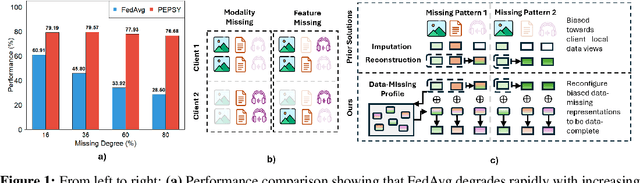
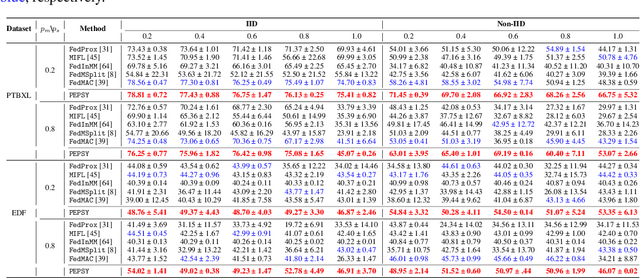
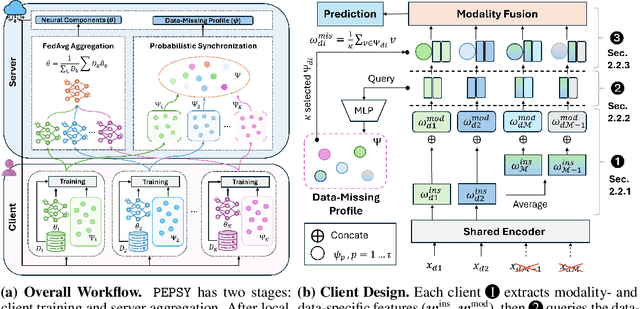
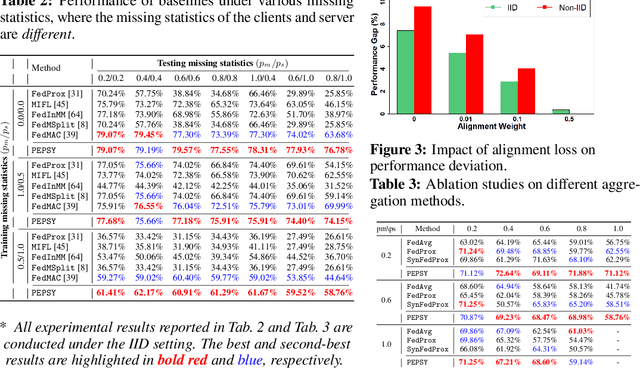
Multimodal federated learning in real-world settings often encounters incomplete and heterogeneous data across clients. This results in misaligned local feature representations that limit the effectiveness of model aggregation. Unlike prior work that assumes either differing modality sets without missing input features or a shared modality set with missing features across clients, we consider a more general and realistic setting where each client observes a different subset of modalities and might also have missing input features within each modality. To address the resulting misalignment in learned representations, we propose a new federated learning framework featuring locally adaptive representations based on learnable client-side embedding controls that encode each client's data-missing patterns. These embeddings serve as reconfiguration signals that align the globally aggregated representation with each client's local context, enabling more effective use of shared information. Furthermore, the embedding controls can be algorithmically aggregated across clients with similar data-missing patterns to enhance the robustness of reconfiguration signals in adapting the global representation. Empirical results on multiple federated multimodal benchmarks with diverse data-missing patterns across clients demonstrate the efficacy of the proposed method, achieving up to 36.45\% performance improvement under severe data incompleteness. The method is also supported by a theoretical analysis with an explicit performance bound that matches our empirical observations. Our source codes are provided at https://github.com/nmduonggg/PEPSY
Expressive and Scalable Quantum Fusion for Multimodal Learning
Oct 08, 2025The aim of this paper is to introduce a quantum fusion mechanism for multimodal learning and to establish its theoretical and empirical potential. The proposed method, called the Quantum Fusion Layer (QFL), replaces classical fusion schemes with a hybrid quantum-classical procedure that uses parameterized quantum circuits to learn entangled feature interactions without requiring exponential parameter growth. Supported by quantum signal processing principles, the quantum component efficiently represents high-order polynomial interactions across modalities with linear parameter scaling, and we provide a separation example between QFL and low-rank tensor-based methods that highlights potential quantum query advantages. In simulation, QFL consistently outperforms strong classical baselines on small but diverse multimodal tasks, with particularly marked improvements in high-modality regimes. These results suggest that QFL offers a fundamentally new and scalable approach to multimodal fusion that merits deeper exploration on larger systems.
Boosting Offline Optimizers with Surrogate Sensitivity
Mar 06, 2025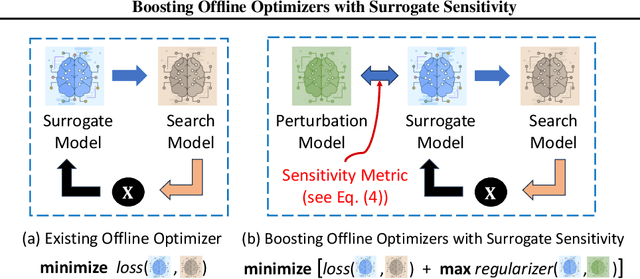
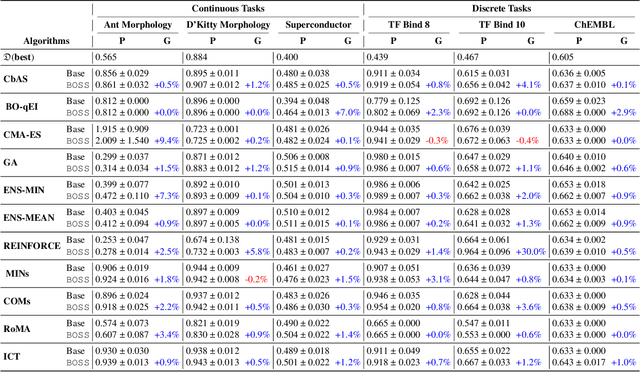
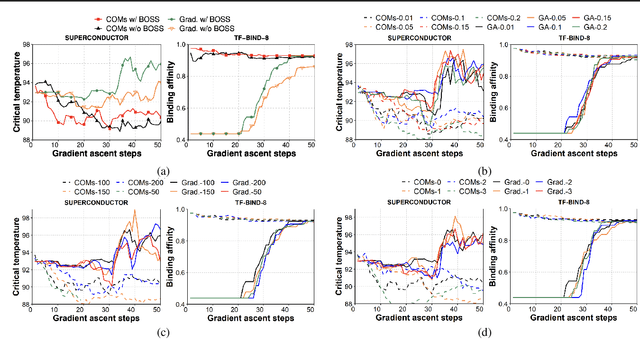
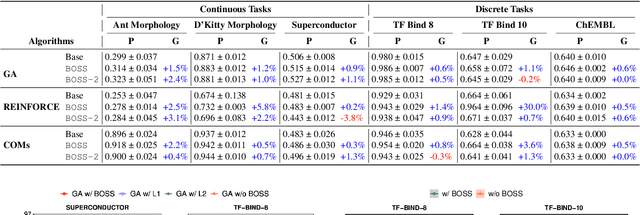
Offline optimization is an important task in numerous material engineering domains where online experimentation to collect data is too expensive and needs to be replaced by an in silico maximization of a surrogate of the black-box function. Although such a surrogate can be learned from offline data, its prediction might not be reliable outside the offline data regime, which happens when the surrogate has narrow prediction margin and is (therefore) sensitive to small perturbations of its parameterization. This raises the following questions: (1) how to regulate the sensitivity of a surrogate model; and (2) whether conditioning an offline optimizer with such less sensitive surrogate will lead to better optimization performance. To address these questions, we develop an optimizable sensitivity measurement for the surrogate model, which then inspires a sensitivity-informed regularizer that is applicable to a wide range of offline optimizers. This development is both orthogonal and synergistic to prior research on offline optimization, which is demonstrated in our extensive experiment benchmark.
Incorporating Surrogate Gradient Norm to Improve Offline Optimization Techniques
Mar 06, 2025Offline optimization has recently emerged as an increasingly popular approach to mitigate the prohibitively expensive cost of online experimentation. The key idea is to learn a surrogate of the black-box function that underlines the target experiment using a static (offline) dataset of its previous input-output queries. Such an approach is, however, fraught with an out-of-distribution issue where the learned surrogate becomes inaccurate outside the offline data regimes. To mitigate this, existing offline optimizers have proposed numerous conditioning techniques to prevent the learned surrogate from being too erratic. Nonetheless, such conditioning strategies are often specific to particular surrogate or search models, which might not generalize to a different model choice. This motivates us to develop a model-agnostic approach instead, which incorporates a notion of model sharpness into the training loss of the surrogate as a regularizer. Our approach is supported by a new theoretical analysis demonstrating that reducing surrogate sharpness on the offline dataset provably reduces its generalized sharpness on unseen data. Our analysis extends existing theories from bounding generalized prediction loss (on unseen data) with loss sharpness to bounding the worst-case generalized surrogate sharpness with its empirical estimate on training data, providing a new perspective on sharpness regularization. Our extensive experimentation on a diverse range of optimization tasks also shows that reducing surrogate sharpness often leads to significant improvement, marking (up to) a noticeable 9.6% performance boost. Our code is publicly available at https://github.com/cuong-dm/IGNITE